

You can’t decode 111.90.150.2404 as a valid IPv4 address because the last segment exceeds the maximum value of 255. Each segment in an IP address must be an 8-bit number between 0 and 255. This error may stem from a typo or data corruption, making the address invalid for routing or identification. Understanding how IP segments are structured and validated is key to fixing such issues and ensuring network reliability—explore these concepts to enhance your technical expertise.
Key Takeaways
- The IP segment “2404” is invalid as it exceeds the maximum value of 255 allowed in IPv4 addresses.
- IPv4 addresses consist of four octets, each representing an 8-bit number ranging from 0 to 255.
- “111.90.150.2404” likely contains a typographical error or misinterpretation in the last segment.
- Validating IP addresses requires tools like IP calculators or online validators to detect such format errors.
- Correct IP formatting is crucial for network routing, security, and preventing communication failures.
Is 111.90.150.2404 a Valid IP Segment? Common Errors Explained
When you examine the IP segment 111.90.150.2404, you’ll immediately notice it violates standard IPv4 formatting rules. IPv4 addresses consist of four octets, each ranging from 0 to 255. Here, the segment “2404” exceeds this maximum value, rendering “90.150.2404” invalid within any IP address structure. This error commonly arises from typographical mistakes or misinterpretation of numerical data. You must guarantee each octet adheres strictly to the 0-255 range to maintain valid IP formatting. Additionally, the presence of a four-digit number in the last octet disrupts packet routing protocols that rely on standardized IP segment structures. Consequently, 111.90.150.2404 cannot function as a legitimate IP address due to this critical numeric violation in the 90.150.2404 segment. Furthermore, understanding basic IP formatting rules is essential for anyone working with network protocols to avoid such errors.
Understanding the Technical Meaning of an IP Segment
Errors like the one in 111.90.150.2404 highlight the importance of understanding what each IP segment represents technically. When you analyze an IP address, each segment serves a distinct purpose within network architecture. Here’s what you need to focus on:
- Network Identification: The first segment often indicates the network class or range, helping routers determine where data should be directed.
- Subnetting and Host Allocation: Middle segments split the address into subnetworks and individual hosts, controlling traffic flow and device identification.
- Value Boundaries: Each segment must be an 8-bit number, ranging from 0 to 255, ensuring compatibility within IPv4 standards. Additionally, understanding caching plugins can enhance website performance, just as each segment optimizes data routing in a network.
How to Interpret the Numeric Structure of an IP Segment
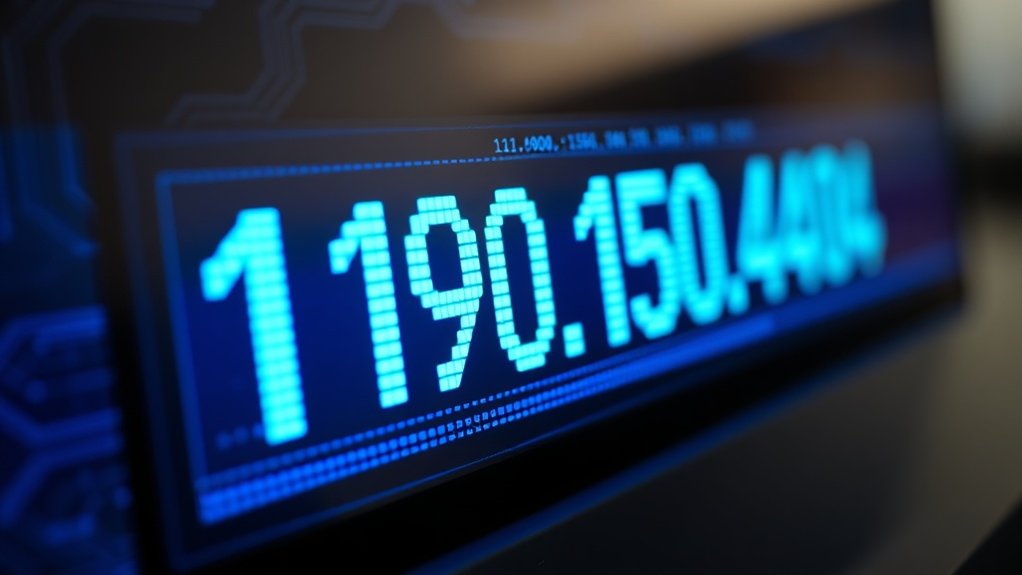
One critical aspect to grasp is that each IP segment represents an 8-bit binary number, which directly translates to a decimal value between 0 and 255. When you interpret these segments, you convert each decimal number back into its binary form to analyze bit-level patterns or subnetting. Each bit position has a fixed value, doubling from right to left (1, 2, 4, 8, 16, 32, 64, 128), enabling you to reconstruct the segment’s decimal value by summing the active bits. This numeric structure also defines the range and hierarchy within IP addressing schemes. By understanding this binary-decimal relationship, you accurately interpret network classes, subnet masks, and host ranges embedded within each segment, ensuring precise technical analysis of IP data. Additionally, recognizing the importance of subnetting techniques can enhance your understanding of network segmentation and resource allocation.
Tools to Validate and Decode IP Segments Like 111.90.150.2404
Understanding the binary and decimal interplay within IP segments lays the groundwork for accurately validating and decoding complex addresses like 111.90.150.2404. To handle such segments, you’ll need specific tools designed for precision and error detection. Consider these:
- IP Address Calculators – Convert between decimal and binary, ensuring each octet fits within valid ranges, essential for spotting anomalies like the extra digit in “2404”.
- Subnet Analyzers – Check the logical structure and mask application, helping you understand segment boundaries and validity.
- Online Validators – Automate syntax and format checks, flagging invalid segments quickly to prevent misconfigurations.
Using these tools, you can dissect and verify IP segments methodically, reducing errors and improving your network data accuracy. Regular audits of your plugin management can also enhance overall site performance and security.
Practical Uses for Analyzing and Troubleshooting IP Segment Errors

When you analyze IP segment errors, you gain critical insights that help prevent network failures and security vulnerabilities. By pinpointing malformed or corrupted IP segments like 111.90.150.2404, you can identify packet loss causes, routing misconfigurations, or malicious packet injections. This enables you to optimize network performance by correcting address inconsistencies and ensuring proper segment formatting. Additionally, troubleshooting these errors assists in maintaining compliance with network protocols, reducing downtime, and enhancing data integrity. You’ll also detect and mitigate denial-of-service attacks or unauthorized access attempts exploiting malformed IP segments. Ultimately, this analysis supports proactive network management, allowing you to implement targeted fixes swiftly, minimize disruptions, and uphold secure, reliable communication across your infrastructure. Furthermore, regular performance audits ensure ongoing optimization and identification of potential issues before they escalate.
Frequently Asked Questions
Who Owns the IP Segment 111.90.150.2404?
You can’t find an owner for IP 111.90.150.2404 because it’s invalid; IPv4 addresses only go up to 255 in each segment. Check the address format to identify the correct owner accurately.
Can 111.90.150.2404 Be Traced to a Geographic Location?
You can’t trace 111.90.150.2404 to a precise geographic location due to the invalid IP format. However, if corrected, IP geolocation tools can approximate the region, but accuracy varies and depends on ISP data availability.
What Are the Security Risks of Using IP Segment 111.90.150.2404?
You risk exposure to unauthorized access, data interception, and potential exploitation due to vulnerabilities in that IP segment. Make certain you implement strong firewalls, regular monitoring, and encryption to mitigate attacks and preserve network integrity effectively.
How Does 111.90.150.2404 Relate to IPV6 Addresses?
Think of IPv6 as a vast ocean, while 111.90.150.2404 resembles a drop of water from IPv4. You can’t directly link them since IPv6 uses 128-bit addresses, unlike the 32-bit IPv4 format.
Are There Any Legal Restrictions on Accessing 111.90.150.2404?
You’ll face legal restrictions depending on jurisdiction and data type linked to 111.90.150.2404. Unauthorized access or data extraction may violate laws like the CFAA or GDPR, so always verify permissions and comply with applicable regulations before proceeding.


